
Office removals for Merton Abbey Mills businesses
Posted on 15/07/2026

If you run a business near Merton Abbey Mills, an office move can feel like one of those jobs that looks manageable on paper and then suddenly isn't. Desks need dismantling, files have to stay in order, IT equipment must arrive intact, and the working day still has to keep turning over. That is exactly why Office removals for Merton Abbey Mills businesses deserve a proper plan rather than a last-minute scramble.
This guide breaks the process down in plain English. You will learn how office removals work, what the main risks are, when it makes sense to bring in specialist help, and how to keep disruption low for staff, clients, and equipment. Along the way, we will cover practical checklists, comparison points, and the small details that often get overlooked until the tape is already on the boxes. And yes, those small details matter. A lot.
Why office removals for Merton Abbey Mills businesses matter
Merton Abbey Mills has its own rhythm. It is not a generic business park where every move looks the same. There are studios, creative firms, small offices, customer-facing spaces, and hybrid teams that keep a lot of moving parts under one roof. When a business here relocates, the move affects more than furniture. It affects time, reputation, staff confidence, and the flow of work.
That is why a well-run office relocation is about continuity, not just transport. If files go missing, someone spends half a day hunting for a printer cable, or the new workspace is not ready when staff arrive, the cost is felt immediately. Not always in invoices either. Sometimes it is the quieter stuff: tired people, missed calls, a day that just feels messy. To be fair, most business owners know that mess is expensive.
For Merton Abbey Mills businesses, the local context also matters. Access routes, parking, loading, narrow time windows, and shared premises can all shape the move. A good removal plan accounts for these realities early. That is where using a structured service such as the wider removal services overview can help you understand what is available before committing to a move date.
How office removals for Merton Abbey Mills businesses work
An office move usually follows the same broad pattern, but the detail changes depending on the size of the business, the type of equipment involved, and how much downtime you can tolerate. In practice, the process works best when it is treated like a project with stages rather than a single day with a van.
1. Initial survey and planning
The first stage is a practical review of what needs moving. That includes desks, chairs, storage units, monitors, small appliances, archived documents, and anything awkward or fragile. A careful survey helps the removal team identify access issues, packing needs, and the number of vehicle journeys likely to be required.
2. Packing and labelling
Packing is where many office moves either stay neat or become chaotic. Good labelling is not glamorous, but it is crucial. Boxes should be marked by department, room, or workstation so that the new office is easier to set up. If you have suppliers or client files that must remain separate, say so early and keep them in a controlled pack. That little bit of discipline pays off later.
3. Dismantling furniture and protecting equipment
Desks may need to be dismantled, shelves emptied, and delicate items wrapped properly. IT equipment deserves special care, especially if it is expensive or data-sensitive. A competent mover will use appropriate protective materials and load items in a way that reduces shifting during transit.
4. The move itself
On move day, the aim is simple: keep the route efficient and the loading sequence logical. Heavy items go first, fragile items are secured, and access points are used carefully so people and property stay safe. If the move is timed around your business hours, the team should work to minimise interruption. Some firms choose early morning or evening moves for that reason, which is usually sensible.
5. Unloading and setup
Once everything reaches the new premises, boxes and furniture should go to the right rooms. A well-run office move includes enough thinking ahead to make this straightforward. The last thing anyone wants is a box of cables dumped in the meeting room with no clue what it belongs to. We have all seen moves like that, and they are never as funny on the day as they sound later.
Key benefits and practical advantages
A properly managed office relocation gives you more than a change of address. It can improve how the business functions from day one in the new place.
- Less downtime: planning keeps your team working while the move happens.
- Reduced damage risk: trained handling lowers the chance of broken furniture or damaged electronics.
- Better organisation: labelled items are easier to unpack and reconnect.
- Stronger staff experience: people feel calmer when the move has structure.
- Cleaner start in the new office: you do not begin the next chapter buried under loose cables and mystery boxes.
There is also a commercial advantage that is easy to miss: professionalism. Clients and staff notice when a business moves neatly. It sends a message that the company is organised, careful, and serious about continuity. In a place like Merton Abbey Mills, where many businesses rely on reputation and relationships, that matters more than people admit.
For businesses that need temporary holding space, storage can be a very useful part of the plan. If that sounds relevant, take a look at storage options in Colliers Wood as part of a staged move strategy.
Who this is for and when it makes sense
Office removals are not only for large companies with dozens of staff. In fact, many Merton Abbey Mills businesses that need relocation support are smaller than people assume.
This kind of move makes sense if you are:
- moving from one office unit to another within the local area;
- downsizing after a hybrid-working shift;
- expanding into more suitable premises;
- combining storage, stock, or admin space into one location;
- upgrading from a short-term setup to a more permanent office;
- needing to move with limited interruption to client service.
It also makes sense when the move includes more than just furniture. If you have archive boxes, specialist equipment, or fragile items, you may need a more tailored approach than a simple van-and-go service. That is where a conversation with an experienced local removal company can help you judge the scale properly.
Not every move needs a huge team. Sometimes a leaner solution is enough. For compact office setups, short-distance support, or lighter loads, a man and van service can be a sensible fit. It is not the answer to everything, of course, but for the right job it can be efficient and cost-conscious.
Step-by-step guidance
If you want the move to go smoothly, treat it as a sequence of decisions. Here is a practical way to approach it.
- Set your move objective. Are you reducing space, improving access, or relocating for growth? Be clear about the reason, because it shapes everything else.
- Inventory the office. List furniture, IT kit, files, stock, and any items that need special handling. It sounds basic, but a good inventory saves arguments later.
- Decide what should move, store, or be discarded. There is no point paying to move old chairs nobody wants. A move is a great excuse to sort out clutter.
- Choose the timing carefully. Pick a window that matches your trading pattern, staff availability, and any access restrictions.
- Plan the packing system. Use room labels, colour coding, or numbered boxes. Pick one system and stick to it.
- Protect data and sensitive materials. Keep confidential documents secure and separate where required.
- Prepare the new office first. Check keys, utilities, entry routes, lift access, and where furniture should go.
- Confirm insurance and safety arrangements. Make sure the move is covered appropriately and everyone knows the safety plan.
A quick tip from experience: the best office moves are the ones where someone owns the process from start to finish. Not necessarily the loudest person in the room, just the one who keeps the list moving. Without that, details drift. And drifting details are how move day gets weird.
Expert tips for better results
These are the small improvements that make a real difference.
Keep an essentials box for the first day
Pack one clearly marked box with the absolute basics: chargers, power leads, stationery, passwords if they are stored securely, a basic tool kit, tea bags, and anything needed to get one workstation live quickly. People underestimate how useful this is. Then, about 9:15 on day one, they remember.
Move IT in a controlled sequence
Computers, monitors, routers, and peripherals should be disconnected and packed methodically. If possible, photograph cable layouts before removal. It is not fancy, but it helps. One photo can save twenty minutes of frustrated guessing later.
Use storage for phased relocations
Sometimes the new office is ready before all the old kit has a home. In that case, a phased move is smarter than forcing everything through at once. Short-term storage gives you breathing room and prevents the new space from becoming a temporary warehouse. For practical support, you may also want to review packing and boxes guidance before you start gathering supplies.
Build in a buffer for delays
Even the best-planned moves can run into parking delays, last-minute access changes, or staff availability issues. A small time buffer keeps stress down. It is one of those boring recommendations that turns out to be brilliant when needed.
Brief staff before the day
People work better when they know what is expected. Tell staff what to pack, what stays with them, where to report, and who is responsible for which part of the move. Silence creates confusion. Confusion creates duplicate work. Simple, really.
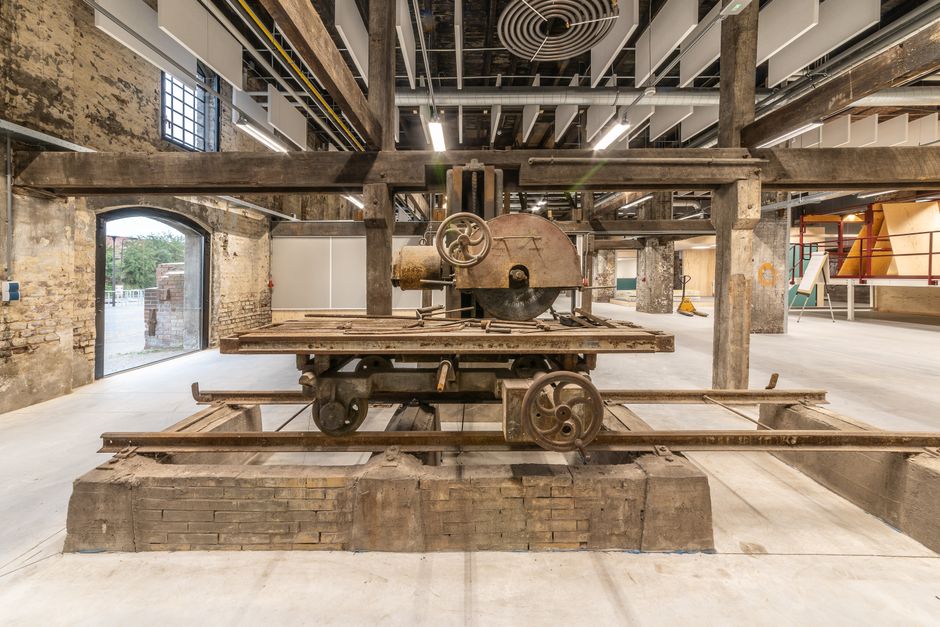
![Inside an industrial building with exposed brick walls and steel ceiling beams, there is an old, rusted circular saw machine mounted on a wooden platform with metal wheels and rails. The machine is positioned on a concrete floor, with various wooden and metal components nearby. In the background, there are open doorways leading to other sections of the building, and a modern yellow floor scrubber is visible on the right side, indicating cleaning or maintenance activities. The space is well-lit, with natural and artificial lighting illuminating the area, and there are wooden and metal structures supporting the upper level or mezzanine. The scene appears to be an early stage of building renovation or industrial clearance, with no furniture or boxes present for house or office removals, but the photograph exemplifies the working environment involved in moving or demolishing industrial equipment or preparing premises for a house or business relocation, as handled by [COMPANY_NAME].](/pub/blogphoto/office-removals-for-merton-abbey-mills-businesses2.jpg)
Common mistakes to avoid
Office moves rarely go wrong because of one huge error. More often, they unravel through a pile of little ones.
- Leaving packing too late: if the move starts the night before, you are already behind.
- Failing to label boxes clearly: vague labels like "misc" do not help anybody.
- Ignoring access constraints: tight loading areas and awkward entrances can change the entire schedule.
- Not separating fragile or confidential items: mixed loads create risk.
- Underestimating the IT set-up: the move is not done when the desks arrive.
- Overpacking boxes: heavy archive boxes can split, and nobody enjoys that sound.
- Forgetting to tell clients or suppliers: if your contact details change, update them early.
The truth is, many office removals go smoothly because someone asked the awkward questions in advance. Where can the van stop? Who has the keys? Which boxes must be unpacked first? The awkward questions are usually the helpful ones. Funny how that works.
Tools, resources and recommendations
You do not need a mountain of equipment, but the right basics keep everything easier.
| Tool or resource | Why it helps | Best use |
|---|---|---|
| Sturdy boxes | Protect files, small equipment, and mixed office items | General packing and categorising by department |
| Bubble wrap and covers | Reduces damage to fragile items and screens | IT equipment, framed items, glass-fronted furniture |
| Labels and markers | Keep the move organised and speed up unpacking | Room allocation and priority boxes |
| Trolley or sack truck | Helps with heavier loads and repeated trips | Archive boxes, printers, bulkier furniture |
| Storage space | Makes phased moves and decluttering easier | Temporary overflow or staged relocation |
If your move is small and straightforward, a lighter vehicle option may be enough. In those cases, a removal van service can be useful. If you need a broader service with loading support and a bit more flexibility, then local removal services are worth comparing against your own internal capacity.
For businesses that want to understand the team behind the service before booking anything, the company background and approach can be a reassuring place to start.
Law, compliance, standards and best practice
Office removals are not usually complicated from a legal point of view, but they do touch on areas where care matters: health and safety, access, insurance, data handling, and working practices. That means it is worth thinking beyond the van and looking at how the move is managed overall.
For example, manual handling should be kept sensible. Heavy items need proper lifting technique and suitable equipment. That is common sense, but in a rushed move people often forget common sense until their back reminds them. Health and safety planning should also cover safe access routes, clear floors, and communication between anyone moving items and anyone setting them down.
Data and confidential documents deserve extra caution. If your office handles personal records or commercially sensitive information, those items should not be left loose in open boxes or moved without a clear chain of responsibility. Best practice is simple: limit access, label carefully, and keep sensitive packs separate where possible.
Insurance should also be checked before move day. Do not assume every item is covered in every scenario. Ask how property, loading, transit, and unloading are handled. If the terms and conditions matter for a particular move, read them slowly rather than skimming. That is the dull advice, yes, but it saves headaches later.
For a closer look at the business's own safety commitments, you can also review the health and safety policy and the insurance and safety information. If you are comparing payment methods or want reassurance around transactions, the payment and security details are useful too. Small things, but important ones.
Options, methods and comparison
Not every office move needs the same level of support. The right option depends on size, complexity, and how much risk you want to keep off your own desk.
| Option | Best for | Pros | Trade-offs |
|---|---|---|---|
| Full office removals service | Larger or more complex business moves | More support, better planning, less burden on staff | Usually the most involved option |
| Man and van | Smaller loads and short-distance relocations | Flexible, practical, often quicker to arrange | Less suitable for multi-department moves |
| Phased move with storage | Businesses that cannot relocate everything at once | Reduces pressure, allows gradual setup | Needs careful coordination and extra planning |
| Self-managed move | Very small offices with simple contents | Can seem cheaper at first glance | Higher workload, more risk, more hidden time costs |
There is no universal winner here. The best choice is the one that fits your business reality. A tiny studio move and a seven-person office do not live in the same world, even if they are only a few streets apart. For businesses near busy local routes or with tighter access, you might also find that man with a van support is the cleanest fit for a smaller relocation.
Case study or real-world example
Here is a realistic example from the kind of move local businesses often face. A small creative team based near Merton Abbey Mills decides to move to a slightly larger unit because hybrid working has changed how much space they really need. They are not huge, but they do have a mix of desks, storage, monitors, samples, and paper archives. The team also cannot afford to lose a full day of client contact.
Instead of trying to move everything in one frantic burst, they split the process into phases. First, non-essential storage goes out. Then desks and shared equipment move. Finally, the IT setup and the daily-use boxes follow once the new office is ready. The result is not glamorous, but it works. Staff can keep answering emails, the move stays organised, and no one is standing around wondering where the kettle has gone. Which, let us be honest, is always a significant question.
The key lesson from this sort of move is simple: a business relocation is smoother when you respect the order of operations. The office does not need to be perfect on minute one. It just needs to be usable. That shift in mindset helps reduce pressure a great deal.
Practical checklist
Use this checklist in the lead-up to your move.
- Confirm the new office address and access arrangements.
- Decide which items are moving, storing, recycling, or disposing of.
- Create a box labelling system and assign responsibility for it.
- Back up and secure essential digital files.
- Notify staff, suppliers, and clients of the move date.
- Check furniture measurements and room layouts at the new site.
- Arrange parking, loading access, and any site permissions needed.
- Prepare an essentials box for the first day in the new office.
- Review insurance, terms, and any service notes before move day.
- Set a realistic unpacking plan for the first 24 to 48 hours.
If you want to compare service levels before committing, it can also help to review the wider removals page and the pricing and quotes information so you understand how the scope of work may affect your budget and timing.
Get a free quote today and see how much you can save.
Conclusion
Office removals for Merton Abbey Mills businesses are rarely just about shifting furniture. They are about protecting time, keeping people calm, and making sure the business can keep functioning while the change happens. The best moves are planned carefully, packed sensibly, and handled by people who understand that every office has its own quirks.
If you get the foundations right - clear labelling, realistic timing, safe handling, and a clean setup at the destination - the move becomes much less painful. Still a move, of course. Still a bit of work. But not a disaster. And that is the goal, really.
For businesses that want a smoother next step, a carefully managed removal service can turn a stressful relocation into a controlled handover. One box at a time. One room at a time. It all adds up.

